Flow blockers: Why can’t you get into flow and stay there?


By FLOWN
•
Apr 07, 2026
It’s a ‘problem’ when flow is treated like a mindset problem. As if the right playlist or a late-night decision should be enough to get into a flow state.
Usually, and we’ve seen this with our FLOWN community, flow state blockers are creating a mess.
Most people struggle because something is in the way. Their attention is already scattered before they begin.
Flow blockers are the hidden friction points that make deep work harder than it needs to be.
Flow blockers: What stops you from getting into flow?
Flow blockers are the things that stop focus from settling into something deeper.
Some are obvious, like notifications or constant interruptions. Others are quieter. A task that feels too big to start or an ADHD brain that is already tired.
In other words, flow blockers are anything that breaks the conditions flow needs in order to happen.
Common flow blockers
Here are some of the most common flow state blockers this article will unpack in more detail:
unclear goals (you need strong and measurable goals)
tasks that feel too hard or too easy
constant interruptions
multitasking and context switching
attention residue from previous tasks
stress and self-pressure
mental fatigue and poor sleep
starting work without a clear next step
reactive work environments
too much open mental clutter
If you’re just getting started learning about the flow state, perhaps you should start with our guide on “What is flow state” and then bounce back.
Flow blockers are not a willpower problem
When flow does not happen, people tend to turn it into a moral issue. They assume they are distracted, lazy, undisciplined, bad at focus, and whatnot.
Let us assure you, the problem is less personal than that.
Flow state depends on a few fragile conditions. The work has to be clear enough to enter, demanding enough to stay interesting, and protected enough for attention to hold.
When those conditions are missing, the brain does what brains do. It fights you with bare knuckles, wanders away into the abyss, stalls, or finds a fly on a wall, a rather peculiar thing to observe for the next time block.
That is friction. If you’re trying to get into a flow state, you should embrace it and engineer against it.
What blocks flow state, according to research
Research on flow keeps pointing back to the same basics. Flow is more likely when there is a strong goal, a good match between challenge and skill, enough feedback to feel progress, and enough uninterrupted attention.
That means most flow blockers are really easy to spot. It’s work that is too easy to hold attention or too hard to enter. Constant switching. Half-finished tasks that keep tugging at the mind. A day built around interruption instead of immersion.
In other words, flow usually breaks long before motivation enters the picture.
Why flow breaks down in three different places

Most advice about flow treats focus like one single moment. Either it happens or it does not.
Things don’t work this way
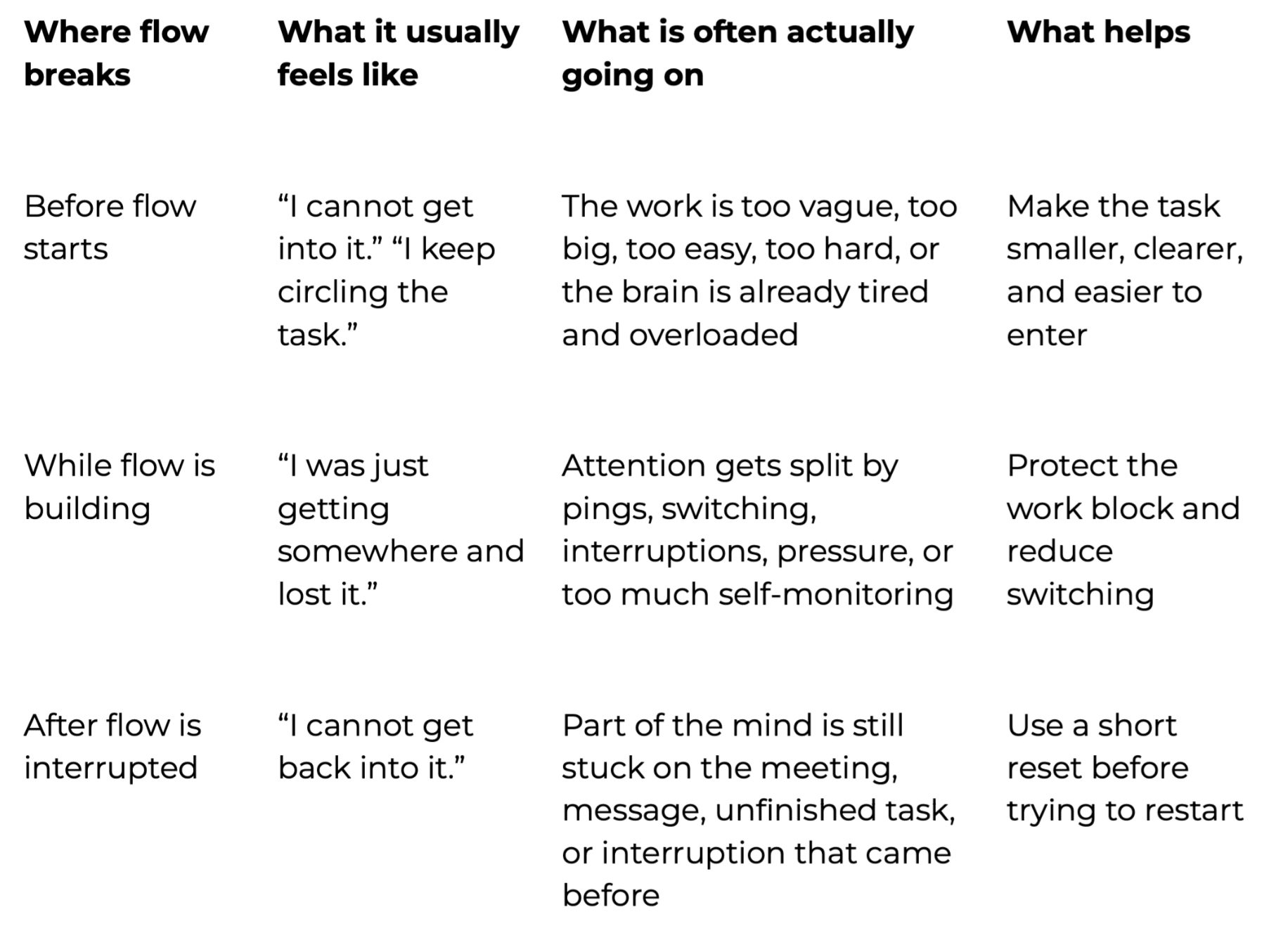
If we were to be super practical here, we’d say flow tends to break in three different places.
Sometimes the problem shows up before the work even begins.
Sometimes it breaks the moment attention starts to deepen.
Sometimes the hardest part is getting back in after something pulls you out.
The fix depends on where the breakdown is happening.
Blockers that stop flow before it starts
Before work even begins, the mind may already be dealing with too much friction.
Sometimes the task is too vague to enter. Sometimes it feels too big to begin cleanly. Sometimes the brain is tired, overstimulated, or still carrying the residue of everything that came before.
Common blockers before work starts include:
unclear goals
no clear next step
work that feels too big or messy
work that feels too hard or too easy
overwhelm
boredom
perfectionism
emotional resistance
stress or mental clutter
low energy or poor sleep
This is one reason why we created a flow state meditation practice.
It is designed for the moments before work, when the mind needs help slowing down and crossing the threshold into focus.
Blockers that break the flow while you are working
This is where fragmentation takes over. Focus starts to deepen, then something slices through it. The task is still there, but the attention is no longer fully inside it. Part of it is now somewhere else.
Our community members often report this exact problem. August, as seen on Trustpilot, shared how “It’s been a major struggle to focus and stay on task that I started.”
Common blockers during work include:
notifications
interruptions from other people
multitasking
context switching
checking email or messages mid-task
too many open tabs or open loops
reactive work environments
unclear feedback while working
self-monitoring and second-guessing
pressure to respond quickly to everything
Flow needs continuity. It needs enough uninterrupted time for the mind to stop hovering and start absorbing. That is why even small disruptions can do more damage than they seem to.
This is also why body doubling apps work so well for this kind of blocker. They create a container for attention.
The presence of another person working alongside you adds structure without pressure. In turn, as our own body doubling survey data points to, people find it easier to stay on task, resist distractions, and keep focus from leaking away.
Blockers that stop you from getting back into flow
This is the most frustrating version. The interruption may be over, but the mind has not fully come back to the state of flow.
The meeting ends, and the work is in front of you again, but the momentum is gone.
Common blockers after interruption include:
attention residue from the previous task
unfinished thoughts or open loops
emotional spillover from a meeting or conversation
decision fatigue
lost context
forgetting where to restart
the pressure to “get back in” too quickly
mental resistance after a broken rhythm
When this happens, the problem is usually not motivation. It is re-entry. The brain often needs a moment to recover the thread before it can go deep again.
How to identify your personal flow blockers

If the real issue is overwhelm, then before you start, removing distractions will not solve much. If the problem is re-entry after interruption, a better to-do list will not fix it either.
The useful question asks where the flow state tends to break.
Do you struggle most before, during, or after focus?
A simple way to spot your biggest blocker is to notice when things usually go wrong.
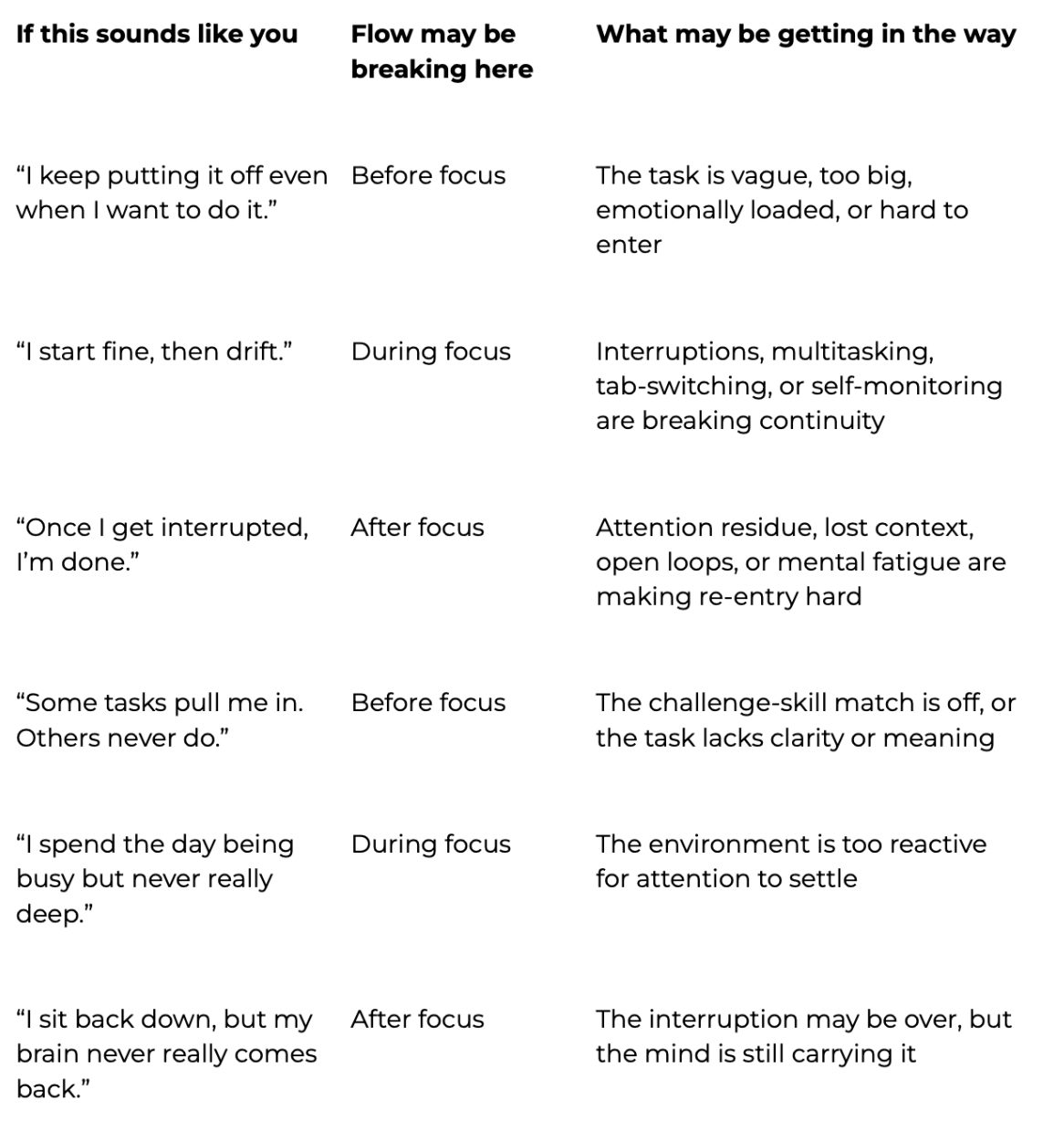
The goal here is not to label yourself. It is to notice your default friction point. That is where the real fix usually starts.
The 10-minute flow blocker audit
If focus has felt off lately, take ten minutes and walk through the last work session that did not go well.
The point is not to judge it but to get specific.
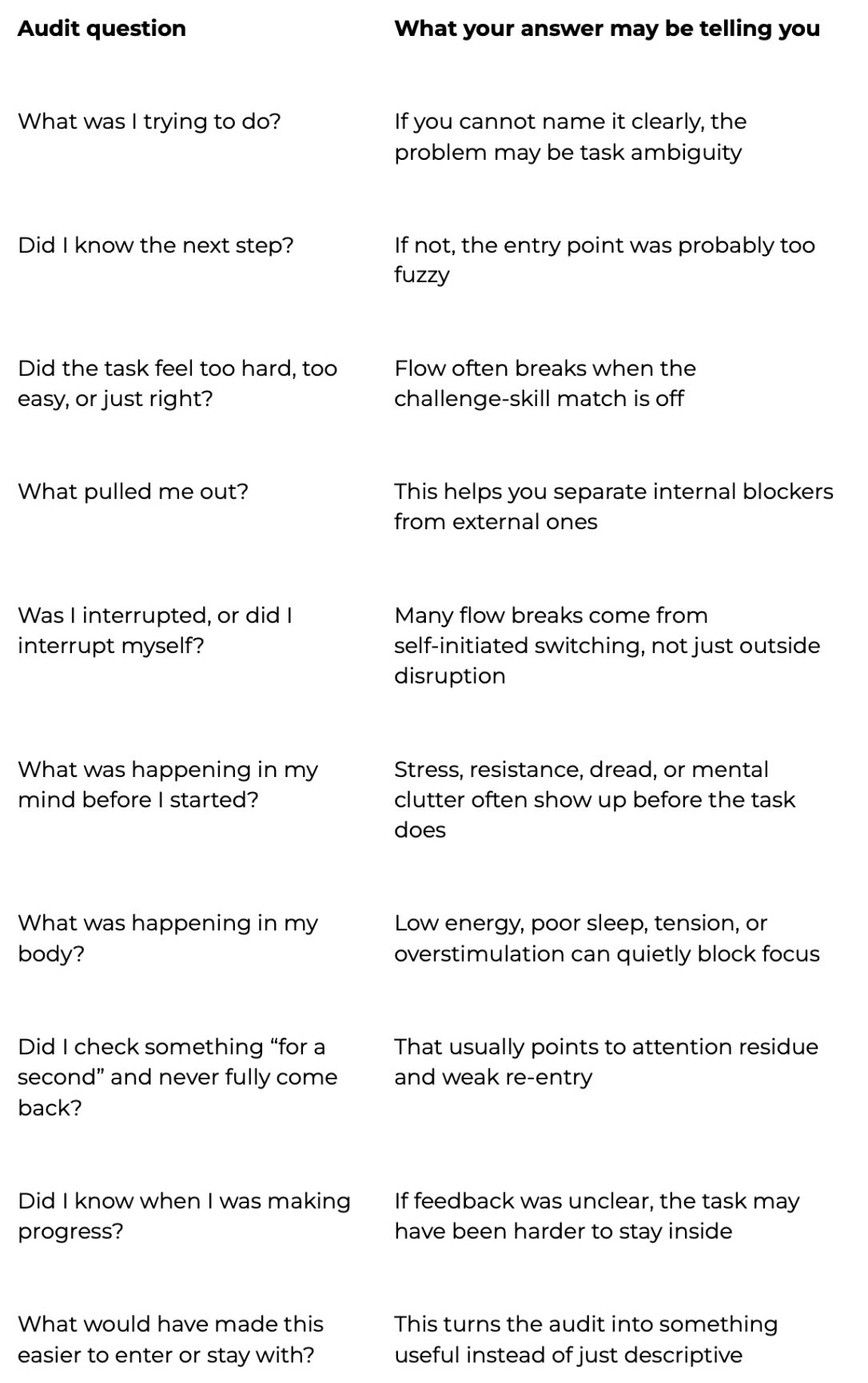
What makes this valuable is not honesty. It is the specificity. “I was distracted” is too broad to help. “I opened my email because the next step felt unclear” is something you can actually work with.
Look for patterns, not one-off bad days
One bad session does not reveal much. Everyone has off days. The useful clues show up in repetition.
If the same kind of friction keeps appearing, pay attention.
Maybe your flow breaks before you start whenever the task feels undefined. Maybe it breaks during work whenever you leave your inbox open. Maybe the real issue is not getting interrupted, but never recovering once you are.
That is the level where self-awareness becomes practical.
How to remove flow blockers without relying on motivation

Try harder. Concentrate more. Be more disciplined. Want it more.
Yes, right… That works right up until it doesn’t.
Let’s treat this as a design issue rather than the script for Rocky Balboa 12.
#1 Fix the task before you fix your focus
A lot of focus problems start when the work is fuzzy, too big, emotionally loaded, or hard to enter.
For some people, that shows up as plain procrastination. For others, especially those diagnosed with ADHD, it can feel more like task paralysis or task initiation trouble.
That is why one of the best ways to remove a flow blocker is to make the task easier to begin.
Useful fixes here include making the goal more measurable, defining the next visible action, and shrinking the entry point.
“Write a report” is vague. “Draft the first three lines of the intro” is something the mind can start flirting with.
This also matters for people dealing with time blindness. If a task feels endless, it becomes much harder to start.
#2 Protect attention before you start
If the day is built around pings and constant switching, focus has to keep restarting from scratch. That is exhausting.
Close the loops you do not need open.
Put the phone away.
Keep one task visible.
Use focus apps or time blocking apps if they help create a cleaner container for attention.
These tools are not magic, but they can reduce decision fatigue and make deep work more likely.
Body doubling can be especially useful here. For many people, and often for those with ADHD, the presence of another person working quietly alongside them creates just enough structure to stop attention from leaking.
For some people, accountability coaching can help too. Not because someone needs to be watched. These regular check-ins and support around planning can make it easier to wear the cloak of a happy and productive individual.
#3 Use recovery rituals after interruption
Even when the interruption looks small, the effect often isn’t. The mind usually needs a little re-entry nudge here.
A short recovery ritual can help:
take one quiet minute before restarting
write down the exact next step
do a quick brain dump of whatever is still pulling at you
re-read the last few lines, notes, or draft paragraph
restart with the smallest visible action, not the whole task
These rituals reduce friction. They help the brain recover context instead of forcing it to rebuild everything from scratch.
#4 Support the brain, not just the calendar
Some flow blockers are not productivity problems. They are bandwidth problems.
If your hope of flow state is built on a foundation of bad sleep, honestly, forget about it.
And sleep is just part of the puzzle. We explain this in detail in our guide on how to get into a flow state. There’s overstimulation, stress, lack of ADHD friendly activities, etc.
And yes, ADHD can change the picture. It can make task initiation harder, time blindness stronger, and self-regulation more effortful. The support here needs to be even more intentional.
That is why good tools are built around more than one route into focus.
For some people, that looks like body doubling. For others, it is time management coaching, a focus app, a time blocking app, or an RSD meditation practice that helps the mind settle before work begins.
And for readers who are navigating ADHD specifically, our ADHD Hub brings together science-backed ways to make focus more accessible in everyday life and work for those who truly crave it.
Flow is easier when you stop blaming yourself
A lot of focus advice online suggests that if you were more disciplined and “serious,” flow would happen.
Well, hopefully, we’ve done our part in explaining that THIS IS THE DESIGN ISSUE.
A blocked task is not a personal failure. A distracted brain is not a character flaw.
Flow gets easier when the goal is not to force it, but to make space for it. That is often enough to change everything. And it was definitely enough to change the lives of hundreds who’ve joined FLOWN.