Classroom accommodations for ADHD students (Evidence-based)

By FLOWN
•
Feb 23, 2026
Some school days are hard in a way that’s invisible from the outside.
A student with an ADHD who struggles to focus can be trying their best and still miss instructions, lose track mid-task, or get labeled as “disruptive” when they’re really overloaded.
The right classroom accommodations don’t lower the bar. They remove the friction so learning has a fair shot.
Classroom Accommodations for ADHD: Quick Answers
Classroom accommodations are changes to the environment, instruction, or assessment conditions that reduce disability-related barriers (without lowering learning standards).
Schools can also provide classroom treatments (like behavioral classroom management and organizational training), which are more like interventions than accommodations.
Here are 6 simple, easy-to-grasp takeaways from the article:
The best accommodations don’t lower standards. They remove friction so the student can show what they actually know.
The strongest evidence supports a few “core” supports. Behavioral classroom management, daily behavior report cards, fast feedback, clear routines, self-monitoring, and organizational systems tend to move the needle most.
Consistency beats complexity. Pick one or two target behaviors, keep goals specific and winnable, and run the support the same way for a couple of weeks before changing anything.
Structure helps attention stay intact. Short work bursts with planned breaks can prevent the classic ADHD crash, and it’s a format students often respond to, including in FLOWN-style structured focus sessions.
“Preferential seating” only works when it’s practical. Reduce obvious distractions and use subtle active seating when needed, then trial it for 1–2 weeks and track whether it actually helps.
Some popular supports have mixed evidence. Note copies and extended test time can help certain students, but they’re not the first place to start. It’s smarter to match accommodations to the specific barrier and review results after 2–4 weeks.
How we chose what goes on this list (the evidence ladder)
A lot of accommodation lists online are basically “popular ideas.” Some are great. Some are harmless-but-vague. And some are so broad you can’t tell if they’re being implemented well.
For this list, we leaned on:
Clinical and public-health guidance (what major bodies recommend schools do)
Systematic reviews/meta-analyses of school/classroom interventions (highest signal for what reliably moves outcomes)
Individual trials where they clarify how an approach is implemented in real classrooms
Also worth knowing: even the CDC notes there’s limited information on which specific accommodations are effective for ADHD. So when evidence is thinner, we’ll label it as such instead of pretending it’s settled.
Below, each accommodation is tagged as strong, good, or mixed evidence. Meaning it’s backed by either multiple studies/meta-analyses, consistent but more context-dependent research, or common use with limited or inconsistent findings.
The evidence-informed list of ADHD classroom accommodations

Each item on the list below shows when an intervention helps, what to do, a little bit of planning nudge, and an evidence note.
#1 Behavioral classroom management (Strong evidence)
This is the approach that makes the classroom predictable. And for a lot of ADHD kids, predictability is calming. Not because they love rules, but because it cuts down the constant guessing and correction that wears them out.
The most effective version is pretty simple. Pick one or two behaviors that matter most right now (for example, “starts work within 2 minutes” or “keeps hands to self”), define what success looks like in plain language, and reinforce it quickly and consistently.
If you want it to actually stick, start small and be very concrete.
Decide what the student earns, how often they can earn it, and what happens when they miss it, then run it the same way every day for two weeks before you tweak anything.
This is very similar to how we structure our FLOWN focus sessions for people diagnosed with ADHD, considering, of course, that they are adults.
Meta-analytic evidence shows that classroom interventions reduce off-task and disruptive behavior in students with ADHD symptoms. These consequence-based approaches tend to perform especially well in group design studies.
#2 Daily behavior report card (DBRC) or home school note (Strong evidence)
This one is underrated because it looks almost too simple.
A DBRC is a short daily feedback loop that keeps everyone aligned, teacher, student, and caregiver, without turning the day into constant lecturing.
You set 2 to 4 measurable goals, the teacher gives quick ratings during the day (or at the end), and home ties it to a small, realistic reinforcement.
The magic is that it turns “behave better” into something trackable and doable.
The biggest implementation win is making the goals strong, specific, and winnable. Like “raised hand before speaking” instead of “show respect,” and keeping the rating fast so it does not become a whole second job.
A meta-analysis of group design studies found that DBRCs can reduce teacher-rated ADHD symptoms. What's more, it shows strong effects when behavior is measured directly.
#3 Immediate positive feedback and specific praise (Good evidence)

A lot of students with ADHD do not need more reprimanding. They need faster signals that they are on the right track.
Immediate, specific praise is one of the easiest ways to do that.
Instead of saving feedback for the end of class, you call out the exact behavior you want to see more of in the moment, like “Nice job starting right away” or “You ate the frog first even though it was harder.”
It sounds small, but it reduces guessing, lowers tension, and makes it more likely the student repeats the behavior.
This fits inside the evidence-backed classroom supports the CDC describes as helpful for students who struggle to stay focused with ADHD.
#4 Token or point system tied to specific behaviors (Strong evidence)
Think of a token or point system as motivation you can see.
It works when the system is boringly consistent, and the goals are crystal clear. Students earn points for observable actions (started within 2 minutes, completed the first 3 problems, used the checklist, transitioned when the timer went off), and they trade those points for something they actually care about.
The biggest mistake is making it complicated or making rewards too far away.
Rather, keep it simple, let them earn often at first, and cash out daily or even per class until the routine is established.
You can also make it quieter and less “babyish” for older students. You could use private tracking (sticky note, small card, pomodoro timer, or time-blocking app) and privileges that feel age-appropriate. This is the way older students can build self-accountability more efficiently.
Token economies are widely used in classrooms. They are supported by research syntheses, and they fit into the consequence-based strategies that show strong effects in classroom intervention meta-analyses for ADHD type behaviors.
#5 Classroom seating accommodations (good evidence)
A lot of preferential seating advice is too vague to help. The useful version is much more practical.
Reduce the automatic distractions (doors, windows, high traffic zones), and if the student benefits from movement, give them a way to move without leaving their seat.
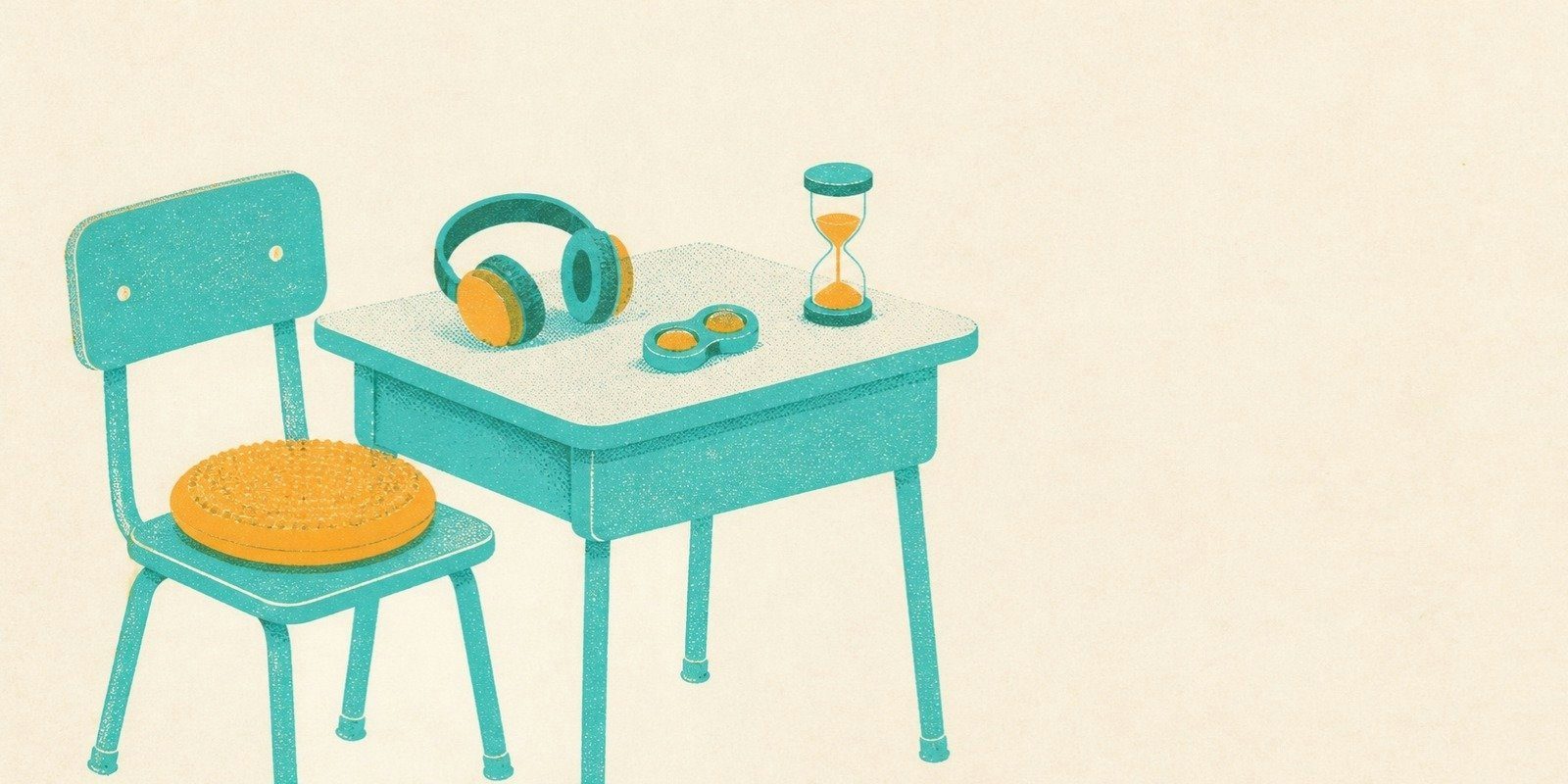
Our seating guide breaks this down really well and links to classroom studies behind options like a dynamic air cushion (including an RCT in a real classroom setting) and therapy ball seating, where some studies found improvements like better on-task behavior and more time in seat.
To implement, start with the least “noticeable” option (for example, a wobble cushion that sits on a regular chair), set one simple rule (“feet stay under the desk, movement stays quiet”), and trial it for 1 to 2 weeks while tracking one outcome (time on task, fewer reminders, better work completion).
If it helps, keep it. If it turns into a toy, swap it for a calmer option or go back to standard seating.
#6 Chunk instructions and check for understanding (Good evidence)

This is one of those accommodations that feels almost too basic until you watch it work.
Many students with ADHD are not ignoring instructions, they are losing steps.
Research suggests children with ADHD can struggle with multi-step instructions. So, they tend to benefit when instructions are supported with action or demonstration instead of only verbal delivery.
Therefore, to keep it practical, you can give one step, have the student do that step, then give the next.
If you need to give multiple steps, write them somewhere visible and ask for a quick “say it back to me in your own words” before independent work starts.
The U.S. Department of Education also calls out breaking work into smaller units as a practical instructional support. The CDC’s classroom supports page points in the same direction. They strongly recommend instruction and assignments tailored to the child.
#7 Short work bursts plus planned breaks (Good evidence)
Instead of asking for 40 minutes of continuous focus and then dealing with the crash, you design the work to fit how attention actually behaves: short sprints with a predictable reset.
The CDC explicitly includes allowing breaks or time to move around as a classroom accommodation. School psychology guidance has echoed this for a long time too.
They note that shorter task duration and breaks can help when attention is limited.
How to make it feel fair (and not like “special treatment”)? Well, you could build breaks into the whole class routine when you can. Think 10 to 15 minutes of work, then 1 to 3 minutes to stand up, stretch, get water, or do a quick reset.
The key is that breaks are scheduled, not earned only after things fall apart.
This is also exactly why our body doubling sessions are structured around short bursts and clear starts.
In our own preliminary 12-week survey of 117 adults with suspected or diagnosed ADHD, sustained focus more than doubled for the tested sample.
Before FLOWN, 81% reported they could not focus beyond 30 minutes. After FLOWN, 52% reported sustaining focus for 60+ minutes, and 69% said FLOWN made it “much easier” to focus.
This is internal, early data, but it lines up with what students often say they need: structure that makes starting and returning easier.
And in our Trustpilot reviews, you see that same student angle show up. One student claimed, “FLOWN has saved my graduate school experience with the accountability I needed.”
#8 Self-monitoring cues (Strong evidence)
Self-monitoring is basically teaching a student to do a quick internal “Am I on track?” scan. The teacher doesn’t have to be the constant external brake pedal here.
The evidence base here is solid in the broader classroom intervention. A meta-analytic review of classroom interventions for students with ADHD symptoms found that classroom interventions reduce off-task and disruptive behavior. It highlights strong effects for self-regulation interventions in single-subject designs as well.
Here’s an implementation cue that does not feel patronizing:
Pick one behavior to monitor (on-task, hands to self, work pace), use a discreet cue (a small sticky note icon on the desk, a watch vibration, a timer beep the teacher controls), and pair it with one fast question: “What am I doing right now?”
If the answer is “not the task,” the reset is also tiny. Open the book, write the next line, do the next problem. You are not asking for a personality change, you are building a repeatable micro-skill.
#9 Organizational skills training (Strong evidence)

If you’ve ever heard “I did it” followed by “I forgot to turn it in”, you’ve already met the real problem.
It usually isn’t effort. It’s the system.
ADHD makes it easier for work to disappear between the desk, the backpack, the classroom bin, and home. Organizational skills training fixes that by making the system so simple it’s hard to mess up.
The easiest way to implement it is to standardize everything.
One folder for “to do,” one for “done.” One place where papers land the second they enter the room. A two-minute end-of-class routine that always looks the same.
Then you actually practice it, like you would practice a drill in sports. You also check it often at first. Daily if possible, then weekly once it sticks.
This approach has a real evidence base. The CDC lists organizational training as a tested strategy for kids and adolescents with ADHD. A meta-analysis of organizational skills interventions found meaningful improvements in organizational skills, with smaller but still present changes in inattention and academic outcomes.
And there are well-cited school-aged studies focusing on organization, time management, and planning difficulties that show these skills can be directly targeted with structured behavioral programs.
#10 Reduce copying demands and support note-taking (Mixed evidence)
Copying from the board sounds harmless until you watch what it demands. The student has to look up, hold the info in working memory, look down, write it, then re-find their place.
For ADHD, that can be a lot of mental juggling for very little learning.
So yes, giving guided notes, an outline, or a copy of key slides could help some students stay with the lesson. But the evidence for “copy of notes” style accommodations is not as strong or consistent as behavior and organization supports.
It can sometimes become a crutch if it replaces learning how to take usable notes.
A smart implementation is to do both. Reduce copying when it is pure busywork, and teach a simple note structure at the same time.
For example: the student fills in key blanks on a guided outline, then adds one line in their own words after each section. That way they get access and skill-building.
Broader accommodations research notes that providing copies of notes is common, but also highlights that accommodations need to be chosen carefully because evidence can be limited and equity questions show up fast.
A randomized trial comparing accommodations (including copies of teacher notes) with interventions suggests the skill-building can outperform accommodation-only approaches.
Reviews of note-taking supports like guided notes discuss benefits while also pointing out the tradeoff that students may not automatically develop independent note-taking skills unless we teach that explicitly.
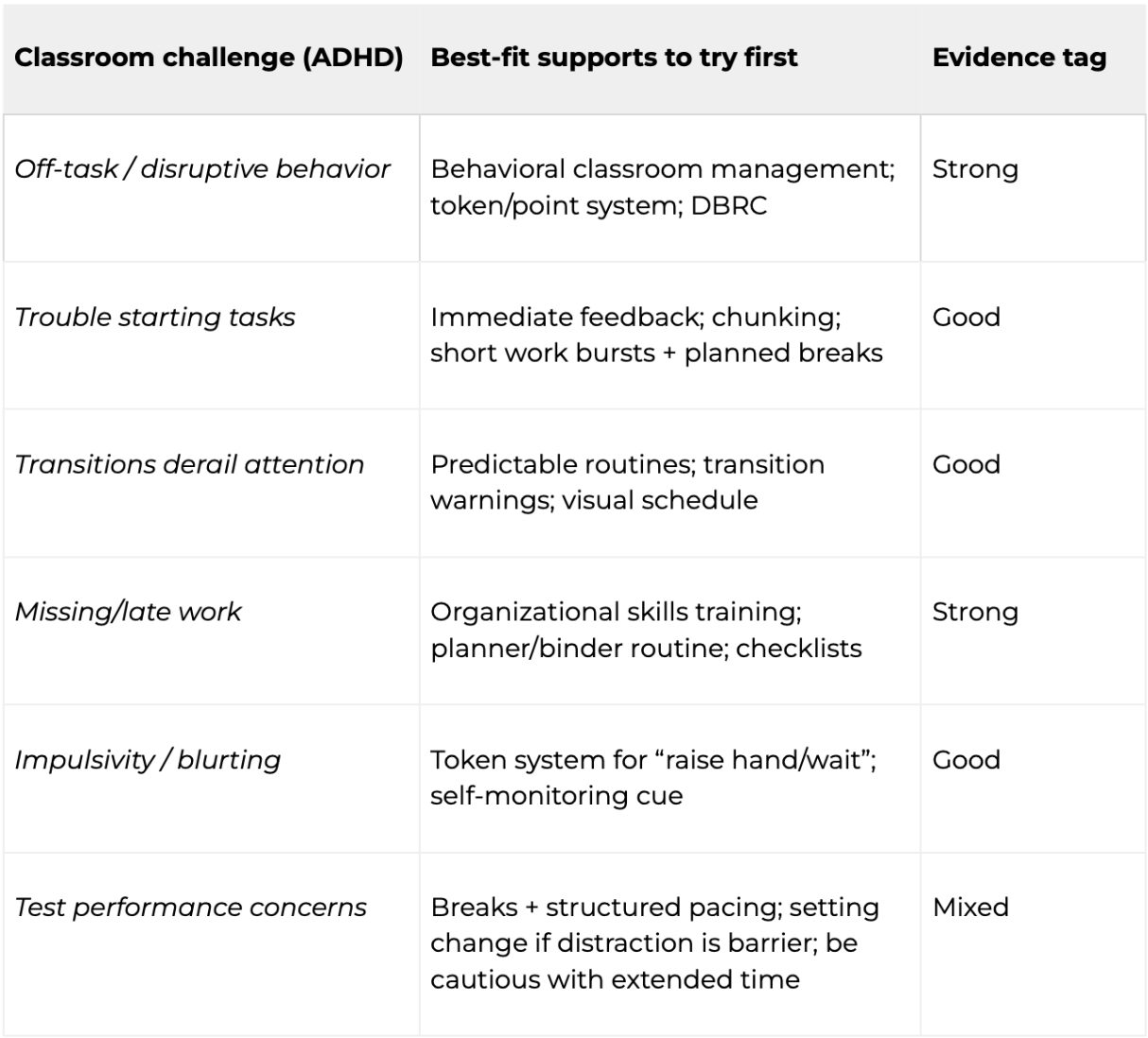
ADHD accommodations by challenge (quick matching table)
504 plan and IEP wording (so accommodations are actually usable)
CDC notes that schools provide supports under laws like IDEA and Section 504.
The easiest way to make plans work is to write them so they’re observable and measurable (who does what, when, how often).
Here’s a simple template that should work just fine:
“During [class/activity], staff will provide [support] at [frequency/trigger], measured by [simple metric], reviewed every [time period].”
Examples you can copy-paste (and customize):
“Teacher will provide 2-minute transition warnings before changes in routine.”
“Student will receive a daily report card with 3 target behaviors; reviewed daily with caregiver.”
“Assignments will be chunked into smaller steps with check-ins for understanding before independent work.”
“Student will receive organizational skills support with weekly monitoring of planner and materials system.”
“Student may take brief scheduled breaks to reset attention without penalty.”
How to tell if accommodations are working (without overcomplicating)
Pick two simple signals and track them for 2–4 weeks:
% of assignments turned in
Number of prompts needed to start work
DBRC targets met per day
If the numbers don’t move, don’t panic. Usually, it’s one of three things: the support isn’t specific enough, it isn’t implemented consistently, or it doesn’t match the real barrier (common with “extended time”).
FAQ about classroom accommodations for ADHD students

You could start with teacher-led behavioral classroom management, a daily behavior report card, and clear routines with immediate feedback. These have the strongest classroom evidence base. Then add organizational skills support if missing work is part of the problem.
Sometimes, but the evidence is mixed and extended time doesn’t consistently provide the “extra boost” people assume. Breaks, pacing supports, or a quieter setting may be a better match when attention fatigue or distraction is the main barrier.
Both can provide support, but they come from different legal frameworks and often differ in how services are delivered. CDC outlines IDEA and Section 504 as the major laws governing services and accommodations for students with disabilities.
Organizational training (planner/binder routines, checklists, pack-up systems) tends to be the highest-leverage starting point according to research. Keep the plan measurable (weekly checks, clear routines) rather than vague.
Match the support to the barrier you can observe: distraction → setting/structure; task initiation → chunking + fast feedback; missing work → organizational systems; behavior targets → DBRC + reinforcement.
The strongest evidence is for structured classroom interventions that shape behavior and routines.
Bottom line: Classroom accommodations for ADHD that actually help
Start with what reliably moves the needle: clear routines, fast feedback, and simple behavior and organization supports that teachers can run every day without burning out.
Then layer in things like seating types, breaks, or note supports only if they match the student’s real sticking point. Check in after 2 to 4 weeks to keep what works and drop what doesn’t.