
Focus can feel fragile with a diagnosed ADHD.
Some days, a small sound pulls you out of your work. Other days, silence feels too empty to think inside. So it makes sense that binaural beats have become popular. They promise a simple way to guide the brain into focus.
Binaural beats may help some people concentrate, but it’s nuanced.
In this piece, we’ll look at what binaural beats can realistically do for ADHD focus, what the science actually says, and how to use them without falling for the hype.
Key takeaways
Binaural beats may help some people with ADHD feel more focused, but they are not a proven ADHD treatment.
The research is still mixed. Small ADHD studies suggest binaural beats may improve subjective studying performance or make homework feel more manageable, but objective attention measures often show weak, limited, or no significant improvement.
The most honest way to understand binaural beats is that they are a possible focus aid, not a fix.
For some ADHD brains, the benefit may come less from “changing brainwaves” and more from creating better conditions for focus. A steady sound can reduce background distraction and become a small ritual that tells the brain you’re initiating a task.
ADHD focus is not always available on command. Sometimes the first win is reducing the friction between perpetually starting and actually working.
What are binaural beats?
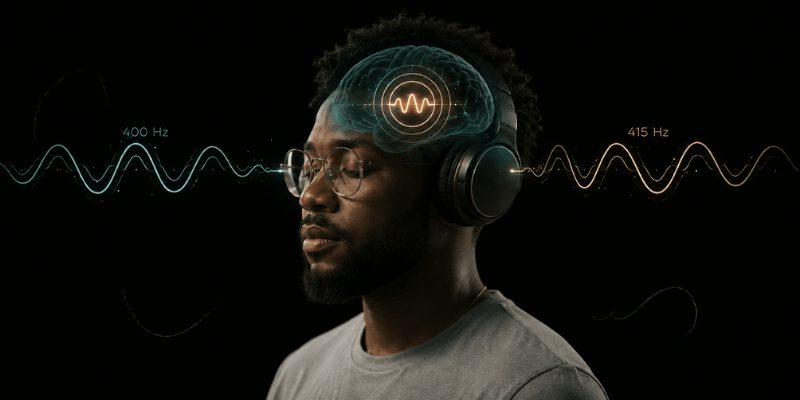
A binaural beat happens when each ear hears a slightly different sound frequency through headphones.
Your brain does not hear the two tones as fully separate. Instead, it perceives a third rhythmic beat based on the difference between them. For example, if one ear hears 400 Hz and the other hears 415 Hz, the brain may perceive a 15 Hz binaural beat.
This is why binaural beats need headphones. Each ear has to receive a different tone for the effect to happen.
Binaural beats are often grouped by frequency bands, such as theta, alpha, beta, and gamma.
These are commonly linked to states like relaxation, calm focus, alertness, or cognitive performance. The popular claim is that binaural beats can “entrain” the brain, meaning they can encourage brain activity to sync with the frequency being played.
That claim is where things get more complicated.
A 2023 systematic review in PLOS One found that the evidence for binaural beat brainwave entrainment is inconsistent. Of 14 EEG studies included in the review, five supported the entrainment hypothesis, eight contradicted it, and one showed mixed results.
The authors also noted that studies varied widely in design, methods, and measurement, which makes strong conclusions difficult. That is the reason why we haven’t included them in these ADHD-friendly activities for adults.
So yes, binaural beats are a real auditory phenomenon. But the idea that they reliably push your brain into a specific state is not yet settled science.
Do binaural beats help ADHD?

Binaural beats may help some people with ADHD focus, but the evidence is too limited to call them an ADHD treatment.
The most useful answer is, well, perhaps, for some people, in some situations.
In one small randomized-controlled study of university students with adult ADHD, participants listened to a 15 Hz binaural beat track while studying. The binaural beats group reported improved subjective studying performance, but the study found no significant changes in ADHD rating scores, mind-wandering scores, or sustained attention task results.
The participants felt their studying had improved. But the objective measures did not show a clear improvement in ADHD symptoms or attention.
This does not mean binaural beats are useless. It means their benefit may be more practical and situational than clinical.
A 2010 pilot study in children and adolescents with ADHD found a similar pattern. Binaural beat stimulation did not significantly reduce measured inattention compared with the control condition. But parents reported fewer homework problems. What’s more, both parents and participants described the method as easy to use and helpful.
Binaural beats may not treat ADHD in men and women, but they might help some people create a better working state.
Why binaural beats might feel helpful for ADHD
For ADHD, focus is rarely just about attention.
It is also about activation. Noise. Boredom. Task paralysis. Emotional resistance. Task switching. You know, the tiny, invisible effort it takes to begin. The even greater effort it takes to stay with something once the novelty has disappeared.
This is why binaural beats may feel anecdotally helpful to some individuals even when the research does not show dramatic clinical effects.
They may create a predictable sound environment. Instead of hearing every notification, footstep, conversation, or weird refrigerator hum, the brain gets one steady auditory layer to sit inside.
They may also reduce decision fatigue. You are not choosing between silence, music, a podcast, lo-fi, brown noise, or the same three songs you have already overplayed into dust. You press play, put on headphones, and begin.
For many people with ADHD, a sound, just like flow state meditation, can become a start cue. The brain learns that this particular audio means work is about to happen. Over time, that cue could, in theory, lower the emotional cost of getting started.
Binaural beats may also provide just enough stimulation to make an under-stimulating task feel more tolerable. This is one reason some people with ADHD prefer working with background noise, light music, or body doubling. Sometimes the goal is to add the right kind of stimulus so the task stops feeling painfully flat.
This is where binaural beats make the most sense.
What does the research actually say?

Research on binaural beats is still early but there are two important things to hold at the same time:
Binaural beats may have real effects under certain conditions.
The evidence is not strong enough to support many of the confident claims made online.
The ADHD-specific research is promising, but small
The ADHD-specific studies are limited and should be read carefully.
The 2022 adult ADHD pilot study found that 15 Hz binaural beats improved subjective studying performance, but did not significantly improve ADHD rating scores, mind-wandering, or sustained attention task performance.
The 2010 child and adolescent ADHD pilot study found no significant reduction in measured inattention, although parents reported fewer homework problems and participants found the method easy and helpful.
If someone with ADHD says binaural beats help them sit down and study, that experience is valid. But it does not mean binaural beats are a proven treatment for ADHD symptoms.
The brainwave entrainment evidence is mixed
A lot of binaural beat content online leans on the idea of brainwave entrainment.
Play a certain frequency, and your brain will move into the matching state. Beta for focus. Alpha for calm. Theta for creativity or relaxation.
The reality is less tidy.
The 2023 PLOS One systematic review found inconsistent evidence for brainwave entrainment from binaural beats. The authors reviewed 14 EEG studies and found no clear answer, partly because the studies used different methods, frequencies, control conditions, and EEG measurements.
Binaural beats may influence attention or mental state under some conditions, but the mechanism is not fully clear, and entrainment should not be assumed.
Attention effects may depend on frequency, timing, and task
The effect of binaural beats may depend on what frequency is used, when the audio starts, what task the person is doing, and whether the beats are combined with background noise.
A 2025 Scientific Reports study found that gamma-frequency binaural beats with a low carrier tone and white noise background improved general attention performance, but did not reduce the drop in vigilance over time.
The beats appeared to help some aspects of attention, but they did not stop attention from fading during a sustained task. That is a very ADHD-relevant distinction.
Many people with ADHD are not only trying to pay attention for one moment. They are trying to keep returning to the task after attention slips. They are trying to survive the middle part, when the task is no longer new but still not finished.
Binaural beats might help some people enter the work state. They may not be enough to keep someone there.
That is why they work best as part of a wider focus system: a clear task, a defined time block, a low-distraction setup, and some form of accountability group or support. For many ADHD brains, sound can help open the door. Structure helps keep the door from swinging shut.
Binaural beat frequencies: What people claim vs. what’s realistic
Different binaural beat frequencies are often linked to different mental states. That does not mean each frequency reliably creates that state.
A more useful way to think about them is as different “sound settings” you can test depending on the task, your energy level, and your sensitivity to sound.
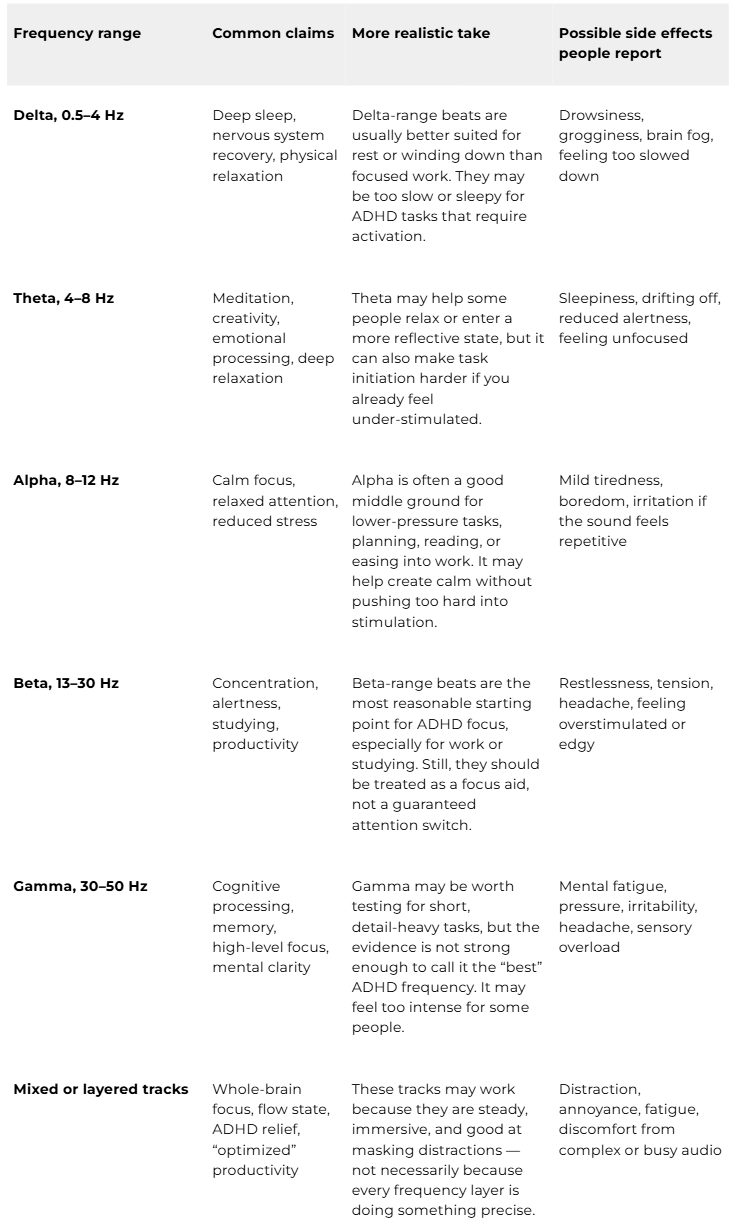
If a frequency helps you start faster, stay with the task longer, or feel less scattered, it may be useful. If it makes you tense, sleepy, irritated, or more distracted, it is not the right tool for that moment.
How to try binaural beats for ADHD without overthinking
Start small. Binaural beats are not something you need to optimize for hours before using. The best test is simple: do they help you begin, stay, and feel a little less scattered?
1. Use headphones.
Binaural beats only work when each ear receives a different tone.
2. Start with 10–20 minutes.
Treat the track as a start cue, not an all-day productivity soundtrack. Press play, open the task, and let the sound mark the beginning of the work block.
3. Try beta-range beats first for work or studying.
Around 14–16 Hz is a reasonable starting point because this range is commonly linked with alert focus and has appeared in ADHD-related research.
4. Keep the task clear.
Don’t use your first test for a huge, emotionally loaded project. Try one specific task: reading one section, replying to emails, planning your day, writing a draft, or doing admin.
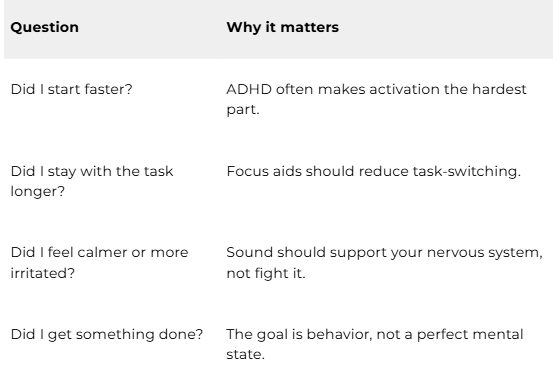
5. Measure what actually matters.
6. Stop if the sound feels bad.
If it makes you tense, annoyed, restless, or overstimulated, it is not helping.
7. Pair the sound with structure.
A clear task, pomodoro timer, a body doubling session, or a virtual coworking block will usually do more than the audio alone. Binaural beats may help open the door to focus, but structure helps you stay in the room.
FAQ about binaural beats

Binaural beats may help some people with ADHD feel more focused, but the evidence is mixed. Small studies suggest possible benefits, especially for studying, but they are not a proven ADHD treatment.
Beta-range binaural beats, especially around 14–16 Hz, are a reasonable starting point for focus. Still, the best sound depends on the person, the task, and how sensitive they are to audio.
Not necessarily. Binaural beats may work for some people, while brown noise, white noise, pink noise, or instrumental music may work better for others. The best choice is the one that helps you start, stay with the task, and feel less distracted.
No. Binaural beats should not replace ADHD medication, therapy, coaching, or professional support. They may be used as a simple focus aid if they feel helpful, but treatment decisions should always be made with a qualified healthcare professional.
No, not in the true binaural sense. Binaural beats require different tones to be delivered separately to each ear, which is why headphones are needed.
They can feel unpleasant or distracting for some people. If the sound increases irritation, restlessness, anxiety, or sensory overload, it is better to stop and try another focus sound.
Final takeaway about binaural beats
Binaural beats are not a cure for ADHD, and the science does not support the bigger claims made online.
But they may still be worth testing as a simple focus aid.
For some people, they can create a steadier sound environment, make starting feel easier, and support a clearer work ritual. The key is to use them with structure, not instead of it.