
ADHD resources
Your guide to all things ADHD, body doubling, procrastination and executive function.
Plus tools that actually work.
🏁
Start here
Understand ADHD
🚀
Get unstuck
Focusing with ADHD
⚙️
Try this
Body doubling and other tools
😌
ADHD at work
Make ADHD
work for you
🏁
Start here: Understand ADHD
Get oriented, feel less “what’s wrong with me?”, and learn the patterns that make ADHD… ADHD.
Start with the basics, then follow the threads that sound like your brain.
⓵ Neurodiversity & ADHD basics
ADHD sits within a broader spectrum of neurodivergent experience.
Before diving into strategies and tools, it helps to understand what that actually means, and why reframing "what's wrong with me?" as "what does my brain need?" is more than just a feel-good shift. It's genuinely useful.

A clear, grounded guide to what neurodiversity actually means.
If you've ever felt like your brain runs on a different operating system to everyone around you, this is a good place to start.
Read the guide

Neurodivergence (including ADHD) shows up in many ways, and no two experiences look exactly alike.
This piece explores what it can look like in real life, useful for anyone trying to make sense of a diagnosis, or figure out whether one applies to them.
Browse examples

The "ADHD as a superpower" idea is everywhere. But is it helpful?
If you’re after a genuinely inspiring take on the ADHD landscape, along with tips, tools and strategies on how to unleash your ADHD strengths, pull up a chair and listen in.
Watch the video

Browse FLOWN's growing library of ADHD-related videos.
From practical strategies to bigger-picture conversations about neurodivergent life.
Browse videos
Back to: 🏁 Start here
⓶ Diagnosis & next steps
Getting diagnosed as an adult can feel equal parts clarifying and overwhelming.
This section covers what to expect from the process, what comes after, and how to navigate practical challenges like medication access.

Are you wondering whether to seek a diagnosis or already in the process?
This article walks you through what adult ADHD assessment actually involves, and how to prepare without overthinking. No jargon, no anxiety spiral required.
Learn what to expect

Navigating the benefits system with ADHD can feel overwhelming, especially when the condition itself makes paperwork harder.
This article breaks down whether ADHD qualifies for disability benefits, what the process looks like, and how to approach it without getting lost in the bureaucracy.
Read the article

When medication access gets disrupted, it can throw everything off.
This article offers seven grounded ways to manage during gaps, whether you're dealing with a shortage, waiting on a prescription, or exploring alternatives.
Read the article
Back to: 🏁 Start here
⓷ How ADHD shows up
ADHD doesn't look the same for everyone. It can be loud and visible, or quiet and internalized.
It can look like procrastination, perfectionism, emotional overwhelm, or an endless need for novelty. Understanding how it shows up for you is a step toward finding the strategies that help you thrive

ADHD in women has historically been underdiagnosed and misunderstood.
This piece unpacks why, and explores common patterns like masking, late diagnosis, anxiety, and burnout that don't always make it into the mainstream conversation.
Read the article

You can look like you're doing fine and still be exhausted by the effort it takes.
This piece explores high-functioning ADHD and the masking patterns that often go unseen, even to the person relying on them.
Read the article

Anxiety and ADHD often tangle together and it can be hard to tell what’s driving what.
Learn how the two interact, why ADHD can fuel anxious loops, and what strategies can help when both are showing up at once.
Read the article

Men with ADHD often spend years feeling inconsistent, restless, forgetful, or emotionally reactive without understanding why.
This guide explains how ADHD shows up in everyday life for men, from work and relationships to sleep, money, and treatment options.
Read the article
Back to: 🏁 Start here, Main topics
🚀
Get unstuck: Focusing with ADHD
Starting is often the hardest part. It’s not because you're lazy or lack “willpower”, but because the ADHD brain doesn't get a natural "go signal" the way neurotypical brains do.
This section is full of practical, ADHD-friendly ways to get into motion, stay in motion, and find your way back when you drift.
⓵ Starting tasks & getting momentum
If you’re stuck in task paralysis, it’s not because of a motivation problem. Your brain just doesn’t get traction on starting like a neurotypical brain does.
Here's what's actually happening, and what you can do about it.

Why can't you start something, even when you want to?
This piece breaks down what's happening in the ADHD brain during paralysis, and gives you practical ways to restart when you're stuck.rain runs on a different operating system to everyone around you, this is a good place to start.
Read the article

Getting started is a skill. And it's one you can get better at.
Learn the specific mechanics behind task initiation and how to build better on-ramps into your work and play.
Read the article

Time isn't hard to manage because you don't care. It's hard to manage because your brain genuinely can't feel it passing. One minute it's 2pm, somehow it's 5pm, and you're not sure where it went.
This piece gets into why that happens, what the research actually says, and the kinds of systems that make time feel more real.
Read the article

Two terms that often get conflated, but they're not the same thing.
If you regularly experience freeze mode or shutdown, understanding the distinction can help you choose the right support.
Read the article
Back to: 🚀 Get unstuck
⓶ Focus & attention
Focus isn't a personality trait. It's a set of conditions.
When you reduce friction, add structure, and work alongside others, it becomes much easier to stay with a task, and to find your way back when attention inevitably wanders.

Less theory, more action.
This piece walks through practical, immediately applicable strategies for reducing focus friction, whether you're working, studying, or just trying to finish one thing.
Read the article

Not every productivity system was designed with ADHD in mind.
This roundup covers strategies that work with ADHD patterns: environmental design, motivation-friendly planning, and systems that don't require you to feel consistently motivated.
Read the article

Hyperfocus can be incredible, and then suddenly it's 2am.
Learn what's actually happening when you slip into hyperfocus, and how to use it intentionally rather than letting it take over the entire day.
Read the article
Back to: 🚀 Get unstuck
⓷ Procrastination patterns
Procrastination and ADHD are deeply connected, but it’s rarely as simple as “I’ll do it later.”
In this section you'll learn to understand what’s driving procrastination, so you can choose strategies that fit.

Why do I procrastinate, and how do I stop?
Spoiler: it's not laziness. Procrastination is an emotional regulation problem, your brain choosing short-term relief over long-term reward. And for ADHD brains, that pull is significantly stronger.
This comprehensive guide will help you develop a better awareness of your own patterns and explore a toolkit of strategies for different kinds of stuckness.
It digs into 15 years of research to explain what's really happening when you delay, and why smart, ambitious people often procrastinate more.

Vague plans don't survive in an ADHD brain.
Learn how being specific about when, where, and how, dramatically increases follow-through.
Read the article

Do the worst thing first. It sounds simple, and it kind of is.
Here's why this method works particularly well for ADHD brains, and how to actually make it stick.
Read the article

Accountability doesn't have to mean pressure.
This piece looks at ADHD-friendly ways to build self-accountability.
Read the article

When you can't see where you're going, starting is nearly impossible.
This piece shows how working backwards from your goal can create the kind of clarity ADHD brains need to get moving.
Read the article
Back to: 🚀 Get unstuck

⓸ Distraction loops & recovery
Every ADHD brain has its escape routes, from doom scrolling, to task hopping.
This section helps build awareness of when you've drifted so you can get back without making the whole day a write-off.

Boredom hits differently with ADHD.
These activities help you re-engage attention, add just enough novelty, and make low-reward tasks feel a little less like wading through sludge.
Read the article

Doomscrolling is a common experience for the ADHD brain. It’s hunting for a quick hit of stimulation and our phones are usually the easiest available.
This piece helps you understand the loop and gives you real ways to break it.
Read the article

Ever have one of those days where everything feels… hard?
This guide offers practical, non-judgemental ways to shift your state when you’re stuck in low-momentum mode.
Read the article

Flow, that "in the zone" feeling, isn't something you summon by trying harder. It shows up when the conditions are right, and you can actually build those conditions on purpose.
This piece walks through what flow actually is, what gets in the way, and explores practical methods for making it happen more consistently.
Read the article
Back to: 🚀 Get unstuck
⓹ Emotions that block action
ADHD isn't just about attention, it's also about emotion.
Shame, overwhelm, and rejection sensitivity can all act as invisible blockers that make it feel impossible to start or continue.
Understanding the emotional side of ADHD is a core part of finding management strategies that work for you.

Saying "I'm fine" when you're anything but takes more energy than most people realise.
This piece looks at what emotional masking actually is, why so many of us default to it, and how to start showing up more honestly, without feeling like you're falling apart.
Read the article

That voice telling you you're faking it, or that your struggles aren't "real enough"? It's more common than you think.
This article explores why imposter syndrome hits differently with ADHD, from masking and self-blame to the years of being told you're just not trying hard enough.
Read the article

Rejection sensitive dysphoria can make criticism, rejection, or even a left-on-read message feel overwhelming.
This guide shares practical books that help you understand RSD, manage emotional spikes, soften shame, and build ADHD-friendly coping tools.
Read the article

Shame has a way of freezing you, and making even small tasks feel loaded.
This guide gently separates shame vs guilt vs regret, explains why your brain clings to the story, and gives you 10 tiny practices to soften the spiral and take one doable next step.
Read the article
Back to: 🚀 Get unstuck, Main topics
⚙️
Try this: Body doubling and other tools
ADHD support doesn’t always require a full life overhaul. Small changes to structure and environment can make a big difference.
This section covers body doubling, apps, sensory supports, and practical everyday helpers that ADHD brains actually use.
⓵ Body doubling
Body doubling is one of the most effective and underrated tools in the ADHD toolkit.
The idea is simple: working alongside someone else, in person or virtually, makes it significantly easier to start, stay on task, and keep showing up.
Here's everything you need to know.
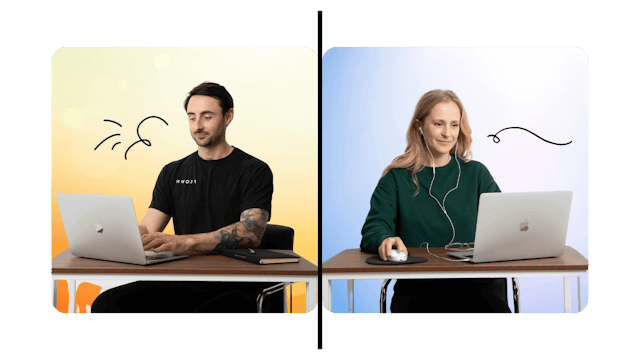
Body doubling: the start button for productivity (and life)
If you've never heard of body doubling, this is where to start. The idea is deceptively simple: work alongside someone else, in person or virtually, and starting, staying focused, and following through all becomes significantly easier. Not because you're being watched. Just because another person is there.
This is the full guide.
What body doubling actually is (and what it isn't)
The seven different formats from library-style co-presence to virtual group sessions
What the research says about why it works
How to set up a routine that your ADHD brain will actually stick with.
If you only read one piece in this section, make it this one.

Time management gets talked about like it's just about being organised.
For ADHD brains, it's something more fundamental. It's the difference between a day that feels possible and one that spirals.
This piece explores why time management matters, why it's genuinely harder with ADHD, and how to approach it in a way that doesn't rely on willpower alone.
Read the article

This guide breaks down the different types of body doubling, from working alongside a friend to virtual co-working sessions, and explains why social presence can reduce start friction in ways that apps and timers simply can't.
Read the article

Can't always find a person to work alongside? These apps bring the body doubling effect to your screen, here's how they compare.
Explore apps

What changes when you add body doubling to your week?
In a study of 117 UK adults with suspected or diagnosed ADHD, it was found that sustained focus more than doubled after 12 weeks of virtual body doubling on FLOWN, alongside lower anxiety and a stronger sense of control over the workday.
Read the article
Back to: ⚙️ Try this
⓶ Calming & sensory tools
Not every ADHD tool is a system or a schedule. Sometimes it's a sound, a visual cue, or an intentional physical setup.
These sensory and environmental approaches can be quietly powerful. especially when your nervous system needs grounding more than strategy.
Sanctuary of Focus: Build a workspace that makes focus easier
Your environment is either working for you or against you.
A sanctuary of focus is an intentional setup (digital and physical) that reduces friction, limits distractions, and makes it easier for your brain to stay in “focus mode.”
Less distraction pull: you remove common attention traps before you start
Less task friction: your tools and next steps are ready, so starting feels easier
More re-entry support: if you drift, your environment guides you back I want to include this as a section under the calming and sensory section part I think

If lists and reminders disappear into the noise, it might be time to try a different approach.
This piece explores how to use what you can see and touch to hold attention, so your environment does more of the cognitive heavy lifting.
Read the article

The right music can make a real difference to focus. Here's what the science says, and how to find your version of it.
Read the article

Certain sounds can help the ADHD brain settle into focus by providing steady, rhythmic stimulation.
This piece explores what the research says and what's worth trying.
Read the article

RSD can hit hard and fast.
This piece looks at whether and how mindfulness and meditation practices can help regulate the emotional intensity that often comes with it.
Read the article
Back to: ⚙️ Try this
⓷ Apps & systems
The right app won't solve everything. but the wrong one will add friction you don't need.
This is a practical roundup of tools worth knowing about, from focus apps to procrastination busters to time blocking systems.

A curated list of apps that actually work for ADHD patterns, covering focus, time awareness, routine building, and habit tracking.
Because not all productivity apps are created equal.
Read the article

From timers to distraction blockers, this roundup covers a wide range of tools for the specific flavours of procrastination that ADHD brings
Read the article

Time blocking is one of the most ADHD-friendly planning methods around. when it's done well.
Here's what to look for in an app that supports it.
Read the article

Accountability is one of the most powerful ADHD supports.
If you can't always access a person for that, these apps can help fill the gap.
Read the article
Back to: ⚙️ Try this
⓸ Everyday helpers
Sometimes the most useful thing is just a template, a tool, or a well-chosen object that makes daily life a little less effortful.
This is the practical stuff, FLOWN downloads, gift ideas, and gear worth knowing about.

Ready-to-use templates designed to reduce cognitive load and make planning, task management, and follow-through easier.
Free to download and made with ADHD brains in mind.
Get the templates

A curated list of actually useful gifts for ADHD life, doubles as a personal wishlist of items that make day-to-day functioning a little smoother. (You're welcome to send it to someone.)
Read the article

Can ADHD glasses genuinely improve focus?
This piece cuts through the claims and looks at what's worth considering, especially if you experience visual fatigue or sensory sensitivity.
Read the article

Your chair matters more than you think.
This piece explores which seating options can help with restlessness, focus, and sensory regulation during long work or study sessions.
Read the article

Cleaning with ADHD can feel overwhelming when task paralysis, time blindness, and too many decisions get in the way.
This guide offers a simple ADHD cleaning checklist with rescue, daily, weekly, and monthly resets to help you start small and make your space feel calmer.
Read the article

AI productivity tools can help ADHD brains plan, prioritise, remember, and follow through with less mental friction.
Compare the best current options, from AI schedulers and task managers to body doubling support for actually getting started.
Read the article

Bullet journaling can help clear mental clutter, but only when each page has a real job.
Explore 31 simple bullet journal page ideas for focus, planning, ADHD overwhelm, work projects, life admin, and creative reflection.
Read the article

Pomodoro breaks work best when they help you reset without losing momentum.
Explore 34 simple break ideas for tired, restless, anxious, distracted, or ADHD brains, so each pause makes it easier to return to focused work.
Read the article
Back to: ⚙️ Try this, Main topics
😌
ADHD at work: Make ADHD work for you
ADHD doesn't switch off when you start work.
This section covers everything from navigating the workplace and understanding your rights, to finding the people and tools that make things feel more sustainable in the long term, not just today.
⓵ In the workplace
Work can amplify ADHD challenges, or, with the right environment and support, it can actually work in your favour.
This section helps you understand how ADHD shows up professionally, what you're entitled to, and how to start advocating for what you need.

ADHD in the workplace
This is a comprehensive guide to understanding how ADHD affects work, and how to approach your environment, your manager, and your own expectations in a way that sets you up to thrive.

You're allowed to ask for what you need.
This piece walks through common workplace accommodations and how to approach the conversation with clarity and confidence.
Read the article

ADHD is a protected condition, but discrimination still happens, often in subtle ways.
This piece covers what it can look like, what your rights are, and how to advocate for yourself if something doesn't feel right.
Read the article

Some roles are genuinely better suited to ADHD brains than others, and it's less about specific job titles and more about the conditions and rhythms of the work.
This piece helps you think about fit beyond the job description.
Read the article

If certain jobs feel like a constant uphill battle, there's probably a reason.
Understanding which conditions make ADHD harder to manage can help you avoid or adapt environments that drain you.
Read the article

An in-depth conversation with Dr Tony Lloyd on what neurodiversity inclusion really means in practice. beyond the policy documents.
A great read for managers, HR, and anyone who wants to understand the bigger picture.
Read the article

The best teams are Moneyball teams, and people with ADHD are often the hire everyone else overlooks.
Alicia on why October is the month to count what ADHD adds, and how ADDA gave body doubling its name.
Read the article
Back to: 😌 ADHD at work
⓶ Support from FLOWN
FLOWN started with a simple observation: ADHD brains get more done when they're not alone. Not because someone's watching, but because the presence of other people working creates a gentle focus cue that the ADHD nervous system struggles to generate on its own.
That's body doubling. And FLOWN is built around it.
Less distraction. More feel-good focus.
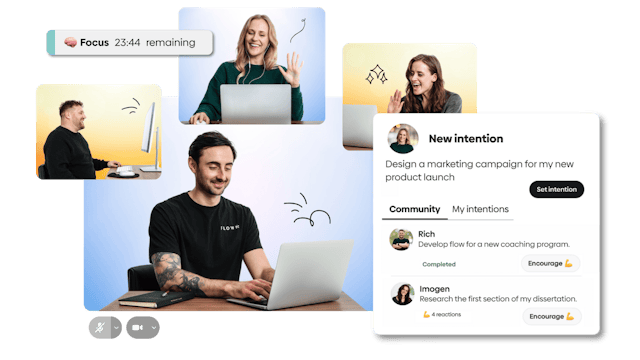
FLOWN is a virtual co-working platform where you work alongside others in live body doubling sessions, and actually get things done.
You join a session, name what you're working on, focus quietly alongside people from around the world, and leave having moved something forward. Simple structure. Real results.
What's inside FLOWN
Everything in your membership: live body doubling sessions, 24/7 co-working, and on-demand tools.
Focus sessions
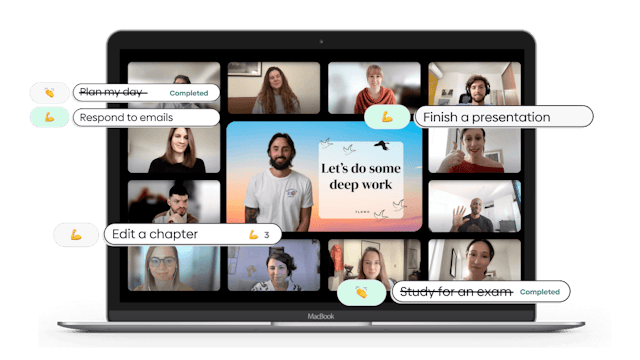
A friendly, structured deep-work format built around intention-setting and gentle accountability.
Set a goal or a short to-do list
Work on your task in the presence of others
Check out at the end and celebrate progress
Led by facilitators or expert community members
Best for: procrastination spirals, ADHD “can’t start”, creative projects, work deadlines, study blocks
🧠 Think of it like a...
gym class for getting stuff done
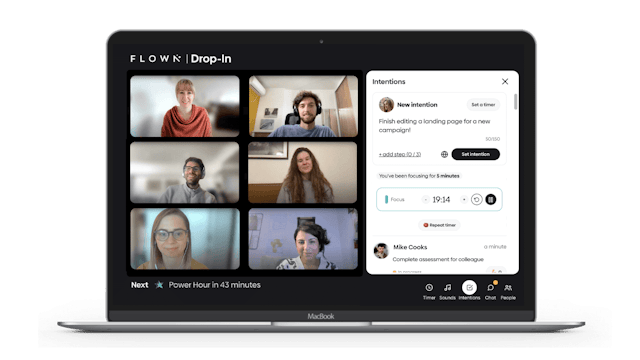
The Drop-in
Your always-open, silent virtual co-working space. Stay as long as you want, whether that’s a 10‑minute sprint or a multi‑hour deep-work stretch.
24/7 online body doubling
Join and leave any time
Self-directed focus: set your own goal and timer
Quiet presence, zero pressure
Best for: quick momentum, late-night bursts, gentle accountability, “I need a fast start”
🧠 Think of it like a...
virtual library or co-working space
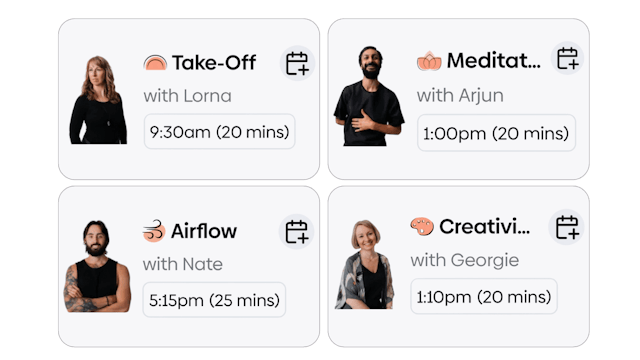
Recharge sessions
Focus isn’t just time management. It’s nervous system management.
Breathwork, journaling, meditation, movement, and other self-care routines
Planning sessions to structure your day/week
Built to help you reset, regulate, and return to your tasks
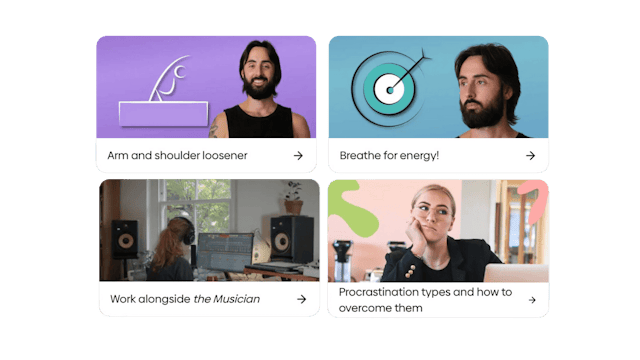
Anytime content
Access the full library of on-demand focus videos and tools to help you drop into deep work on your own schedule.
Focus, recharge and learn on your terms
Meditation, breathwork, focus videos, deep-work tips
Ideal for whenever you can’t join live
Access to Work (UK)
FLOWN can be funded through the UK government's Access to Work scheme.
If you're in the UK and have an ADHD diagnosis, you may be entitled to this support at no cost to you.
Back to: 😌 ADHD at work
⓷ Deeper support with FLOWN Plus
When body doubling sessions aren't quite enough, when you need more structure, more personal support, or a real process for change, FLOWN+ is the next step.
Facilitator-led and expert-designed. FLOWN+ is built for ADHD brains who want both momentum and consistent results.

Small groups with a consistent rhythm.
Ideal if you want the body doubling effect alongside people who understand ADHD, and a reason to show up each week.
Learn more

Work one-to-one with a coach who understands ADHD, to untangle what's getting in the way and build systems that actually fit your brain.
Read the article

A structured 8-week programme for people who want real, lasting change.
Not a course you complete and forget, a process that reshapes how you work.
Learn more
FLOWN is also available for universities and businesses, including team workshops.
Back to: 😌 ADHD at work, Main topics
FLOWN Full ADHD Resource Bank
🟣 FLOWN — Services & tools
For organisations
🎥 ADHD resources — Videos & downloads
📚 Blog articles
Understanding ADHD & neurodiversity
Focus, attention & getting started
Tools, apps & environment